
On Friday our son-in-law, Jacob, left a job site during his workday and took a route past Hagley Park in Christchurch. His day and life changed forever when he drove meters away from the man who was still actively shooting people who wore traditional Muslim dress as the shooter left the Al Noor Mosque in Christchurch. It took Jacob’s brain a while to believe what his eyes were seeing and he, like other bystanders, sprang into action trying to save the lives of those still living. Jacob saw horrific things in the aftermath, but he, unlike those who dressed differently in the same circumstance, went home safe. (And I am so glad that he did!)
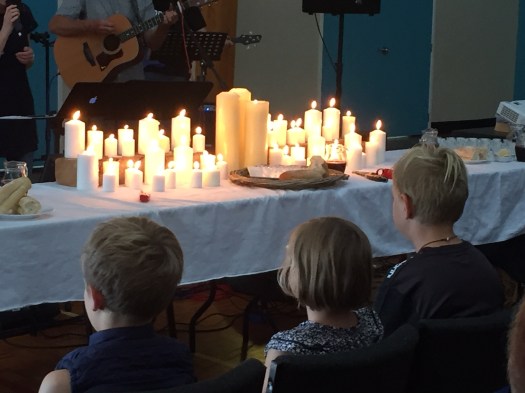
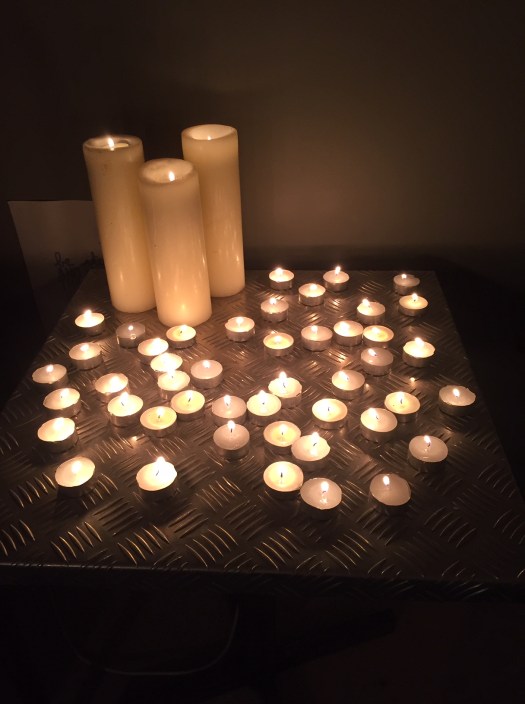
Right before we met yesterday (Sunday), they added another candle. The forty-nine dead from the attack on the Christchurch mosques had just become fifty. Our pastor asked fifty people to come and light a candle. What seemed far too many people went forward—but when they were finished there were still candles unlit and more people were needed.
Fifty, it turns out, is quite a lot.

Someone else read the beautiful prayer that is the New Zealand National Anthem. It speaks of diversity and unity, peace not war, faithfulness and love (really, it’s amazing!). This time, however, I was caught by words near the end that I hadn’t focused on before, ‘Let our cause be just and right.’
As the service continued the phrase echoed around in my head. This is truly a time to actively evaluate what is ‘just and right.’ Not because our cultural background, our present discourse, our personal theology, or our unconscious assumptions say so. Not just what our friends think or what our family taught us: but what is ‘just’ and what is ‘right. I think that each of us is likely deceived if we think we have 100% got the corner of the market on either of those. And dialogue breaks down when we think that we do.
After all the Christchurch shooter thought that he was just and right, too.
I know of no better way to look for what is just and right than to turn to the words of the Prince of Peace:
“One of their religion scholars spoke for them, posing a question they hoped would show him up: “Teacher, which command in God’s Law is the most important?”
Jesus said, “‘Love the Lord your God with all your passion and prayer and intelligence.’ This is the most important, the first on any list. But there is a second to set alongside it: ‘Love others as well as you love yourself.’ These two commands are pegs; everything in God’s Law and the Prophets hangs from them.” (Matthew 22: 36-40, The Message).
Many translations of this verse say, “Love your neighbor as yourself,” sparking a broad range of discussion about who is my neighbor. Jesus answers this question clearly, however, in Luke 10:25-37 when a religious scholar asks him how to gain eternal life. Jesus answers a question with a question:
“What’s written in God’s Law? How do you interpret it?” (vs.26).
The scholar answers Jesus almost word for word with Jesus’ summary of the law written in Matthew.
“Good answer!” said Jesus. “Do it and you’ll live.” (vs. 28).
As human nature has before that and since, the man asked the pivotal question, “And just how would you define ‘neighbor’?” (vs. 29). Jesus replied with the confronting parable of The Good Samaritan where two different religious leaders walk right past a man who was beaten, robbed and injured on the side of the road. Who stopped to help him? His cultural and political enemy who not only picked him up, tended his wounds and carried him to a safe place, but gave financially for his continued care. Jesus ends the story by saying:
What do you think? Which of the three became a neighbor to the man attacked by robbers?”
“The one who treated him kindly,” the religion scholar responded.
Jesus said, “Go and do the same.” (vs. 36-37).
I have to admit that I have yet to learn the name of the man who killed fifty people a few days ago. In fact, there is an honorable sounding movement in New Zealand to not give him the fame that he clearly desires by learning his name, but to learn the names of the fallen instead. But guess who has publicly come out with a message of forgiveness? Farid Ahmed, a Muslim man whose wife was murdered at the mosque on Friday. Mr. Ahmed has chosen to love his enemy because that is what he feels like his wife would have wanted.
‘Let our cause be just and right.’
Of course the shooter must be prosecuted and punished for the safety of society, but I am challenged to see Brenton Tarrant (I looked it up) as a flawed and hurt human being. Of course, laws must be evaluated and procedures reviewed to do things even better if, God forbid, there is another incident, but we also must take up the challenge as individuals to be the healing in a society that produces men like Brenton.
Jacob, my son-in-law and a Follower of Jesus, chose to spend the day after witnessing things no one should ever have to see by intentionally agreeing to be interviewed–because he wanted to spread a message of love. And guess what he did yesterday? He went back to Hagley Park, made friends with an Australian Muslim man named Ayman who was sent to assist with the handling of the bodies for burial. Jacob said, “Today Ayman and I did somewhat of a pilgrimage together as we ate kebabs, walked around the Hagley Park memorial and talked about our families, lives, faiths, trauma and much more.”
“Let our cause be just and right.”

I won’t deny that thousands of Christians were killed in 2018 by Muslim extremists (not the world-wide Muslim majority, but extremists). Does that make me justly angry? Absolutely. But so does fifty Muslims killed by a pseudo ‘Christian’ extremist. We are all souls created in the Image of God. And a person doesn’t have to even remotely believe the same things that I do to be my neighbor.
One of my favorite songs right now says this:
“If we’re gonna fight
Let’s fight for each other
If we’re gonna shout
Let love be the cry
We all bleed the same
So tell me why, tell me why
We’re divided” -Mandisa
I do not expect to ever be a leader on a large scale. I will never write policy, I will never implement governmental change. But I have learned that the BEST and most influential way to change the world is through love, strengthened through Christ’s love, one person at a time. Simply because we are all Imago Dei–made in the image of God. The far reaching impact of love, one by one, not based on race, color, creed or gender will change the world. I think that’s ‘just and right’ and exactly what the Prince of Peace has in mind.
And I continue to evaluate what is ‘just and right’ in my own thinking today.
 Heather Pound
Nice article but…..he shot people because he was against immigration not Muslims per se. He explained all of it in his manifesto in which he never once mentioned being against Muslims but chose this target because he was guaranteed to hit immigrants. Therefore your comment in this article “But so does fifty Muslims killed by a pseudo ‘Christian’ extremist.” is very inflamatory as it was not a religious killing but a political one. The media have made it a religious kiiling. None of it is right but please don’t add to the already inflamed situation by incorrect labelling.
LikeLike
Thanks for your comment, Helen. I agree that this is a point to be careful about! This is something I have pondered as well especially as I am an immigrant. My race is not objectionable to him, but I (as he is ironically, too!) am not NZ born. I, also, have heard that his manifesto (but I don’t think it has been released in it’s entirety?) commented about immigration and, as many white supremeists do, unfortunately quoted the Bible in it. He could have targeted quite a few shopping malls around NZ on a Sunday afternoon where different groups of people go. Or cultural celebrations in different cities—-but he chose mosques. Therefore he did in the execution of his plan at least target people of a certain religion. His victims included native borns NZ’ers as well as a third generation Pakeha woman which reinforces the target of a religion. I think your point is important because I believe it likely in his mind as well as in the minds of so many, certain races and religion are grouped together. Over the years in the countries I’ve lived in or traveled to, I have ALWAYS been assumed a Christian because of my nationality, for example. Whatever his origional intention, he did kill 50 Muslims. The woman in a hijab I spoke in an Auckland shop the other day, clearly felt he targeted her religion, not because of media, but because of who he chose to kill. My son-in-law’s observation on the scene as the shooter left the mosque was him shooting people on the side of the road in traditional Muslim dress. The goal of my blog was to emphasize that all people, simply by being human, are worthy of love and respect. In that particular paragraph my intention was partly to show that there are extremists who do not represent the whole. I do apologize if the impression was inflammatory, however!
LikeLike